

Emirates put a shower on the A380. Here's the seat that wastes it.
The bar and the shower are the reasons to fly it — and exactly why the wrong seat wastes the trip. Here is the seat worth booking in each of the four cabins.
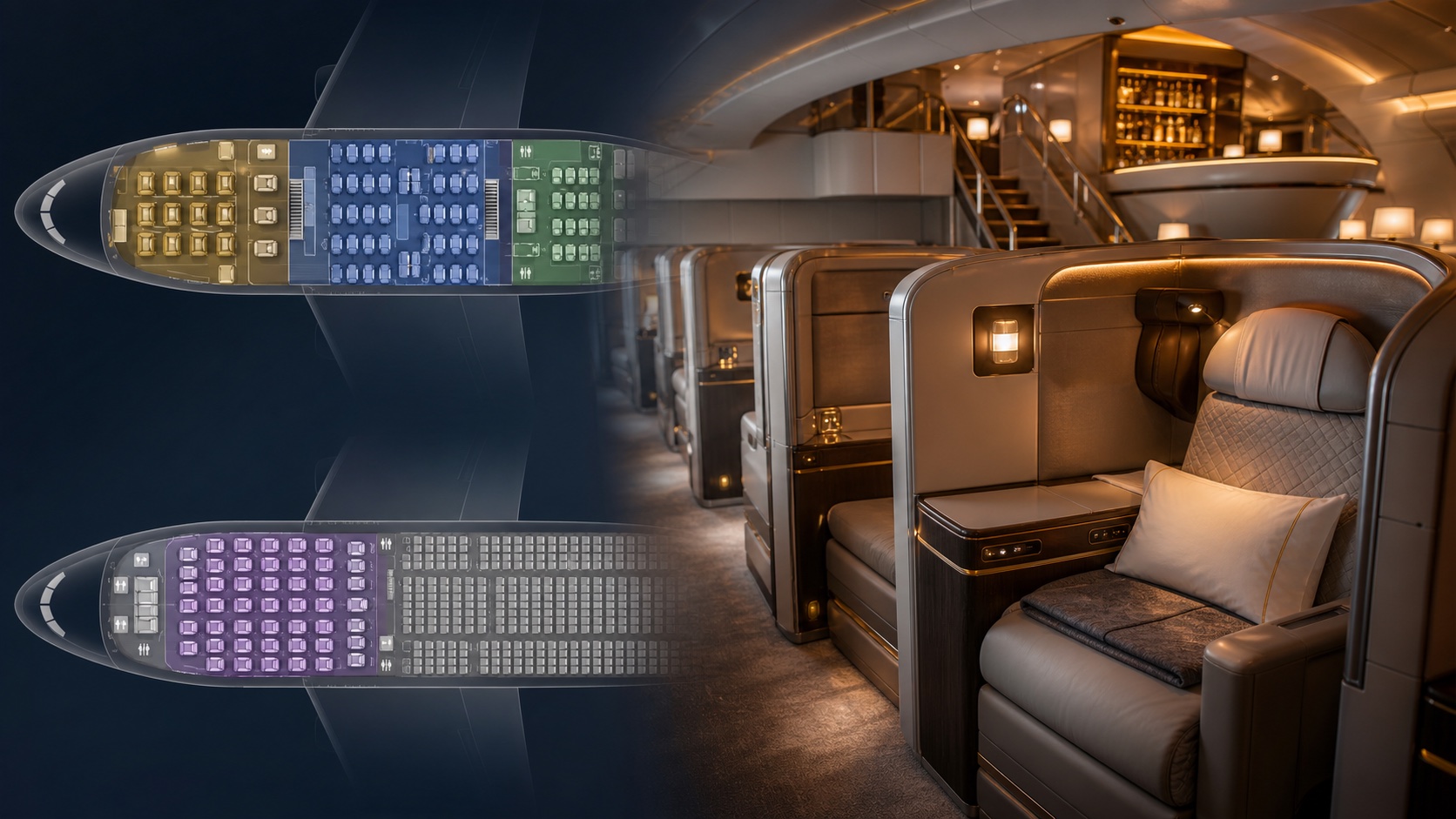
The Emirates A380 puts a bar and a shower on the upper deck, and that is exactly why the wrong seat wastes it. Where you sit matters more here than on almost any aircraft, because the features that make this superjumbo special are the ones that vary most by seat: the deck split, the bar, the shower, the bed lengths.
This guide goes cabin by cabin on the four-class Airbus A380 Emirates flies on its long-haul routes, with the specific seats worth booking and the rows to skip.
For the live seat map on your exact flight, open the Emirates A380 seat map — this guide is its companion, focused on which seats to book and which to skip.
Book: 2A/2K in First, 9A/9K or 16A/16K in Business, window pairs in Premium Economy, and forward or overwing Economy windows. Skip: First row 4, Business rows 24–26, Premium Economy row 40, and Economy row 88.
2A or 2K: window privacy without the row-1 galley trade-off.
A, E, F, or K seats. They get the longer bed compared with aisle-pair seats.
Start forward, then look over the wing. Avoid the last row and rear centre seats.
Emirates A380 cabin layout
The four-class A380-800 seats 484 passengers across two decks:
| Cabin | Seats | Rows | Best first look |
|---|---|---|---|
| First Class | 14 private suites | 1–4, upper deck | Window suites in rows 1–3. |
| Business Class | 76 lie-flat seats | 6–26, upper deck | Windows and centre pairs forward of row 16. |
| Premium Economy | 56 seats | 33–40, lower deck | Window pairs from rows 35–39. |
| Economy | 338 seats | 52–88, lower deck | Forward rows, overwing windows, and exit rows. |
First and Business share the upper deck; Premium Economy and Economy fill the lower deck. The onboard bar sits at the rear of the upper deck, behind Business. Let's go cabin by cabin.
First Class: the suites
Emirates First Class on the A380 is a private suite with sliding privacy doors, a personal minibar, a vanity mirror, and a seat that converts to a fully flat bed. Emirates describes it as an automatic door for full privacy. The floor-to-ceiling enclosure, the virtual windows and the zero-gravity seat belong to the six-suite Game Changer cabin on Emirates' newer Boeing 777s, not to the A380, so do not book the A380 expecting them. Each suite has its own HD entertainment screen: Emirates quotes 32 inches for First Class, and A380s delivered before late 2015 were fitted with 27-inch screens, so the size depends on the aircraft you get.
And then there's the shower. Emirates fits two shower spas on the A380, for First Class passengers only. Shower time is limited, so ask the crew how long the water runs and put your name down early.
The suites sit in a 1-2-1 layout across rows 1–4. Rows 1–3 have window suites (A and K) plus a central pair (E and F); row 4 has only the two window suites.
| Suite | Verdict | Why |
|---|---|---|
| 2A / 2K | Best all-round First picks | Window privacy, one row back from the stairs and the cabin entry. |
| 1A | Best if you want maximum forward privacy | Feels cut off from the cabin, but sits beside the stairs and the entry at the front. |
| 3A / 3K | Strong backup | Window suites that sit a touch further from the front activity. |
| Row 4 | Skip if better windows are open | Backs onto the galley and lavatory block that separates First from Business, so it picks up more movement. |
Book the shower early
First Class passengers reserve a shower slot with the crew after boarding. Book early in the flight — popular times fill fast, and a shower before landing genuinely resets you after a 14-hour leg.
Business Class: the upper deck
Emirates Business Class fills the rear of the upper deck in a staggered 1-2-1 layout, so every passenger has direct aisle access. The columns run A and K at the windows, B/D and G/J on the aisle pairs, and E/F in the centre. Every seat lies flat for sleeping; Emirates does not publish the seat width, and the seat-map references that do put it at about 18.5 inches (47 cm).
Bed length is worth knowing before you choose. Emirates does not publish it, but the seat-map references that measure the cabin put the window and centre seats (A, E, F, K) at around 79 inches (201 cm) and the aisle-pair seats (B, D, G, J) at roughly 70 inches (178 cm). If you're tall, favour a window or centre seat.
Business runs rows 6–26 with no row 13; rows 6 and 22 are short rows with only the centre pair. The seats are otherwise consistent down the cabin, so the choice comes down to position relative to the galleys and the bar.
Business Class seats worth booking
-
Seats 9A and 9K — Window seats in the forward third of the cabin: far enough back from the galley block behind First to stay quiet, far enough from the rear bar to avoid its foot traffic, and a full-length 79-inch bed. The A380's deep windows are a highlight from here.
-
Seats 16A and 16K — Mid-cabin window seats, about as far from both the forward galley and the rear bar as Business gets. Among the quietest seats in the cabin, with the longer bed length of the window columns.
-
Rows 7 and 9 centre pairs (E and F) — Travelling with someone? The centre pairs let you sit side by side, and they keep the longer 79-inch bed length. Sitting forward, they're also well clear of the bar at the back.
-
Seats 11A and 11K — Another solid forward-cabin window pick if rows 9 and 16 are taken, with the same full-length bed and a quiet position between the galleys.
Business Class seats to skip
-
Rows 24–26 — The last three rows of Business sit directly in front of the bar, with the lavatories and rear galley behind it. Expect more foot traffic from passengers heading back for a drink, especially on overnight flights, and the crew's meal-service staging area is close by.
-
Aisle-pair seats if you're tall (B, D, G, J) — These seats are fine for the daytime, but their beds run about nine inches shorter than the window and centre columns. Anyone over six foot should hold out for an A, E, F, or K seat.
The onboard bar
The bar sits at the rear of the upper deck, behind the Business cabin and just ahead of the rear galley. It's a full cocktail bar with snacks, drinks, and standing room — somewhere to stretch your legs on a long flight, open to both First and Business passengers. It's worth a visit even if you don't drink much; it's part of what the A380 experience is built around.
The flip side is the rows nearest it. If you want quiet, book forward in Business (rows 7–16) and walk back to the bar when you feel like it, rather than sitting beside it for 14 hours.
One timing note: the bar fills up about 2–3 hours in. Go during the climb-out or near the end of the flight for a quieter drink.
Premium Economy: the lower deck front
Premium Economy is the newest Emirates A380 cabin, added on the four-class layout. It sits at the front of the lower deck in a 2-4-2 arrangement across rows 33–40, with 56 seats. Emirates quotes pitch of up to 40 inches, a 19.5-inch-wide seat with eight inches of recline, calf and foot rests, and a 13.3-inch screen.
The columns are A/B at one window, D/E/F/G in the centre, and J/K at the other window. Rows 33–34 are shorter, carrying only the window pairs (A/B and J/K) where the cabin narrows.
Premium Economy seats worth booking
-
Seats 35A, 35B and 35J, 35K — The first full 2-4-2 row gives you bulkhead-adjacent legroom without losing a seatmate, and the window pairs are the easiest place to settle in for a long flight as a couple or a solo traveller who wants one neighbour rather than three.
-
Window pairs through rows 36–39 (A/B and J/K) — Mid-cabin window pairs keep you clear of the galleys at either end and give two-seat privacy. Good for couples and for anyone who values a quick view over aisle access.
Premium Economy seats to skip
-
Row 40 — The last Premium Economy row backs onto the cabin divider and the galley behind it, so expect more movement and service noise than rows 35–38.
-
Centre seats D and G in any row — In a 2-4-2 block, D and G are the inner-aisle seats of the centre four. They're fine, but you'll be climbing past or over a neighbour; the window pairs are the better solo pick.
Economy: the lower deck
Emirates Economy fills the rest of the lower deck: 338 seats in a 3-4-3 layout across rows 52–88. Emirates does not publish Economy pitch or width for the A380; seat-map references put them at about 32 inches and 18 inches, standard for long-haul, and the A380's wide fuselage makes the cabin feel less boxed-in than a narrow-body. Every seat has a 13.3-inch screen, USB power, and full meal service with complimentary wine and beer.
Economy seats worth booking
-
The first rows of the cabin (the Economy cabin opens at row 52) — The forward Economy rows pick up extra legroom from the bulkhead ahead. They're the most sought-after Economy seats on the aircraft. Two trade-offs: bassinet positions are here, so you may be near an infant, and the tray tables fold out of the armrests, which slightly narrows the seat.
-
Overwing window seats (mid-cabin, rows 60–70) — Seats over the wing sit at the A380's centre of gravity, the smoothest part of the aircraft, and the wing structure dampens engine noise. Window seats here are among the quietest in Economy, with a dramatic view of the A380's wing.
-
Exit row seats — When available, exit rows offer noticeably more legroom. They're highly sought after and often held for taller passengers or assigned at check-in. Standard exit-row restrictions apply, so check the Emirates A380 seat map for your flight to see which rows qualify.
Economy rows to skip
-
The last row (row 88) — The rearmost row backs onto the lavatories and the stairs, with limited or no recline and foot traffic throughout the flight. It's the least comfortable place to spend a long-haul leg. The final rows narrow too: row 88 carries only the window and inner columns (A/B/C and H/J/K).
-
Centre seats in the back third (D, E, F, G in rows 80–88) — A centre seat at the back of a 338-seat cabin means a long wait to deplane, lavatory traffic on both sides, and the widest part of the cabin between you and either aisle.
-
Seats beside the mid-cabin lavatories — The Economy cabin has lavatories at several points along its length. Seats immediately next to them get noise and queue traffic. Check the Emirates A380 seat map before you pick.
Tips for any cabin
A few things hold true wherever you sit:
-
The A380 is quiet for its size. Four engines mounted below a double-deck structure keep the cabin floor well isolated, so the Airbus A380 runs quieter than most wide-bodies regardless of class. The upper deck (First and Business) is quieter still.
-
Sit over the wing for the smoothest ride. Seats near the A380's centre of gravity — the overwing section, mid-cabin in Economy — feel turbulence less than the nose or tail. Worth aiming for if you're a nervous flyer.
-
Check your specific flight. Emirates runs more than one A380 configuration, and they get updated over time. Confirm the exact layout for your route on the Emirates A380 seat map before you choose.
Check the full Emirates A380 seat map and see how other carriers configure the Airbus A380 across all airlines before you book.
The right seat lifts an already remarkable aircraft. In First, take a window suite in rows 1–3. In Business, target a window or centre seat (A, E, F, K) forward of row 16 for the longest bed and the quietest stretch, and walk back to the bar when you want it. In Premium Economy, hold out for a window pair in rows 35–39. In Economy, aim for the forward rows or an overwing window, and skip the last row and the rear centre seats.
Two honest limits: Emirates flies more than one A380 layout, so confirm your exact configuration on the live seat map first, and the bed-length and shower calls only matter up front. If you are booking Economy on a daytime hop, most of this is noise — take a forward or overwing window and move on. It earns its care on the 14-hour overnight, where the wrong row is the difference between arriving human and arriving wrecked.