

United 787-9: the Polaris seat to skip and the one to book
Four booking experiences share one cabin, and the map will not tell you which rows to skip. We walk all four, name the seats to book, and flag the traps.
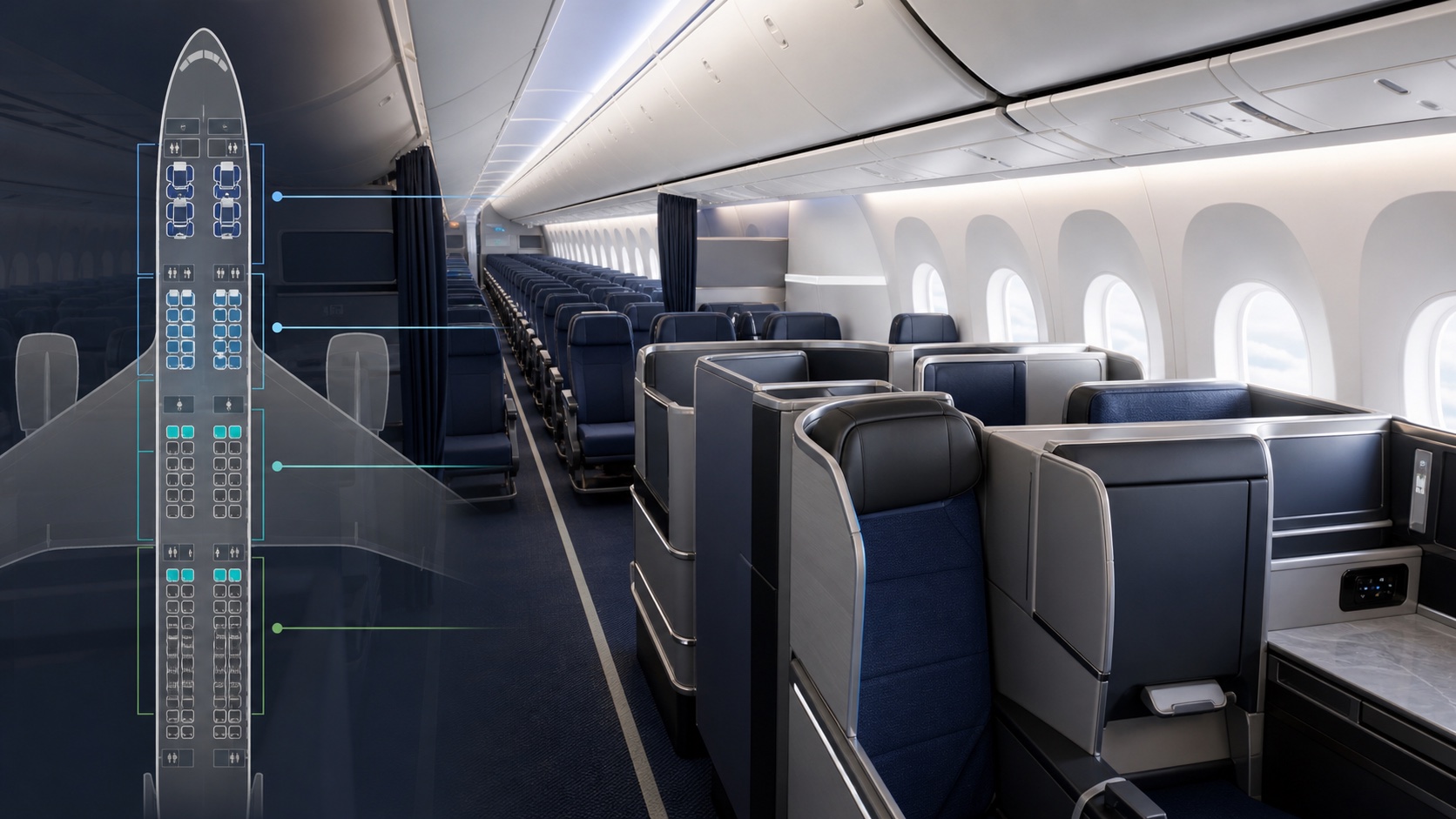
On a 10-hour flight in the United 787-9, the seat you pick is the biggest variable you control, and the cabin map will not tell you which rows to skip. The aircraft runs to 257 seats across four classes (Economy Plus is a designated subset inside the economy cabin, not a separate section), and the gap between the best and worst seat in any single section is the difference between a workable long-haul and a miserable one.
This guide walks the 787-9 Dreamliner cabin by cabin, names specific seats worth booking, and flags the ones to skip.
Book: 3A/3L in Polaris, row 20 or 21 in Premium Plus, row 30 or 42 in Economy Plus, and 35A/35L in standard economy. Skip: Polaris row 12, Premium Plus row 22 centre seats, and rows 56–57 in economy.
3A or 3L: private window position, clear of the busiest galley areas.
Row 30 or row 42 in Economy Plus, depending on whether you value storage or exit-row space.
Rear economy rows 56–57: limited recline, lavatory traffic, and last off the aircraft.
United 787-9 cabin overview
United's standard 787-9 (the 78P variant) is a four-class layout:
| Cabin | Layout | Rows | Best first look |
|---|---|---|---|
| Polaris business | 48 lie-flat seats, 1-2-1 | 1–12 | Window seats in row 3. |
| Premium Plus | 21 seats, 2-3-2 | 20–22 | Row 20 for space; row 21 for storage. |
| Economy Plus | 39 extra-legroom seats inside economy | 30–44 | Rows 30 and 42. |
| Economy | 188 economy seats, 3-3-3 | 30–57 | Forward window seats, then 45A/45L. |
A galley and lavatory block sits between Premium Plus and economy, which is why rows 23–29 don't exist in the seat map. Rows 36–41 are absent for the same reason mid-cabin.
The 787-9 also has the Dreamliner's signature comfort features: larger windows with electronic dimming, a lower cabin altitude (around 6,000 feet rather than the usual 8,000), and higher humidity. These help on every seat in the cabin, but they don't compensate for a poor row choice on a long flight.
A note on column letters
United uses boarding-pass convention on the 787-9 and skips G, H, and I between F and J. Polaris columns run A, D, F, L. Premium Plus runs A, C, D, E, F, J, L. Economy and Economy Plus run A, B, C, D, E, F, J, K, L. The right-side window in economy is column L, not J.
Polaris business class: best seats
Polaris is a fully lie-flat product in a 1-2-1 layout, so every passenger gets direct aisle access. Rows 1–12 share the same seat design; the differences come down to position in the cabin.
| Pick | Why | Watch for |
|---|---|---|
| 3A / 3L | Best all-round window position: private, forward, and clear of the busiest galley areas. | Take 1A only if being first off matters more than galley quiet. |
| 5D / 5F or 7D / 7F | Good centre-pair choices for couples in the odd-row staggered layout. | Even-row centre seats sit further apart. |
| Avoid row 12 | Backs onto the galley and lavatory block between Polaris and Premium Plus. | Noise and foot traffic matter more on overnight flights. |
Premium Plus: best seats
Premium Plus is a 21-seat 2-3-2 cabin in rows 20–22. It's a step up from Economy Plus, with wider seats, more recline, more legroom and an upgraded meal service, without the cost of a Polaris fare.
20A/C and 20J/L give the bulkhead space. You lose under-seat storage at takeoff and landing.
21A/C and 21J/L keep the forward cabin position with normal storage.
22D/E/F puts you in the last row, centre block, beside the economy galley and lavatories.
Economy Plus: best seats
Economy Plus on the 787-9 is a 39-seat subset within economy rather than a separate cabin, with the same seat shell but several extra inches of pitch. The designated rows on this aircraft are row 30 (all nine seats), rows 31–33 (the ABC and JKL triples only, six seats each; the centre DEF seats in these rows are standard economy), row 34 (ABC only), row 42 (the forward exit row, all six seats), and row 44 (DEF only).
| Seat | Verdict | Reason |
|---|---|---|
| 30A / 30L | Best Economy Plus window seats | Forward-most economy row, extra pitch, and a cabin divider ahead. |
| 42A/B/C/J/K/L | Best pure legroom | Forward exit row. Great space, but exit-row rules and no bag at your feet. |
| 34ABC | Only if better rows are gone | Extra pitch, but isolated from the strongest Economy Plus rows. |
| 44DEF | Skip if you can | Centre seats only, no window, and standard economy around you. |
Economy: best seats
Standard economy on the 787-9 is a 3-3-3 layout with two distinct sections separated by a mid-cabin galley block. Rows 30–35 sit forward of that block; rows 42–57 sit behind it. Pitch is tight at around 31 inches, and the row you pick changes the flight more than the meal does.
Best economy seats
-
Row 35 window seats (35A and 35L) — The last row before the mid-cabin galley block, so no one reclines into you. The oversized Dreamliner windows make a forward-cabin window seat in economy genuinely worthwhile.
-
Rows 30–34 window seats (A or L) — The forward economy block has the best windows for views and the quietest position relative to the engines.
-
Row 45 window seats (45A and 45L) — The first standard-economy row past the exit-row pair (rows 42–43). Forward enough in the rear economy section to feel quiet and catch meal service early, without paying the Economy Plus premium.
Economy seats to avoid
-
Rows 56 and 57 — The tapered final rows. The fuselage narrows toward the tail, so these rows are missing seats compared with the rest of economy — check the live seat map before booking to see which columns are available on your flight. Limited recline, immediate proximity to the rear lavatories, and the last off the plane on arrival.
-
Row 55 centre seats (55D, 55E, 55F) — Centre block at the very back. No window, no recline buffer, and you'll be near the rear lavatories for the duration of the flight.
-
Rows 42 and 43 centre seats — The exit rows have only six seats each (ABC + JKL); the centre block D, E, F is absent because of the exit aisle. That's a positive for the seats that exist, but it's worth flagging that there is no centre seat to pick in these rows.
Tips for getting the best seat
-
Book early. The strongest seats — row 30, row 42, and row 35 windows — clear out fastest. Booking early is the most reliable way to get one.
-
Check back 24 hours before departure. Some airlines release held inventory at check-in. It's worth a look, especially for Economy Plus.
-
Use the seat map. Check the United 787-9 seat map before selecting. Configurations vary.
-
Consider the route. On daytime flights, window seats on the side away from the sun stay cooler. On overnight flights, an aisle seat makes it easier to stretch or visit the bathroom without disturbing seatmates.
-
Look at exit rows at check-in. Exit-row seats on United are sometimes released at check-in if they haven't been assigned. Set a reminder for 24 hours before departure.
Dreamliner-specific notes
The 787-9 has a few aircraft-level traits worth factoring into seat choice:
-
Electronic window dimming. There are no shades; the windows dim electronically. Crew can override your setting on long flights to keep the cabin dark.
-
Lower cabin altitude. The composite fuselage allows for a lower equivalent cabin altitude. Most people feel less fatigued than on an older wide-body of similar flight length.
-
Quieter cabin. The 787-9 is noticeably quieter than the 767 or 777. The forward economy section — roughly rows 30–35 — tends to be the quietest; the rear of the cabin picks up more engine noise.
Check the full United Airlines seat maps and explore the Boeing 787-9 across all airlines to compare configurations before you book.
On a 10-hour flight, the seat you pick is the single biggest variable you control. Aim for row 30 or row 42 in Economy Plus, row 20 or 21 in Premium Plus, or row 3 in Polaris; avoid rows 56–57, the row-12 Polaris border, and the row-22 Premium Plus centre block.
One honest limit: United flies more than one 787-9 layout, so confirm your exact tail on the live United seat map before you count on a row, and read the map, not the row number, on any other airline's 787-9. On a short daytime hop where any seat will do, none of this is worth the effort. It is written for the long-haul, where the wrong row is ten hours you do not get back.