

Not all exit rows are equal — here's how to pick the one worth having.
The extra legroom is real, but the row in front of the exit can be worse than a standard seat. Here is how to pick the exit row worth having — and who should skip it.
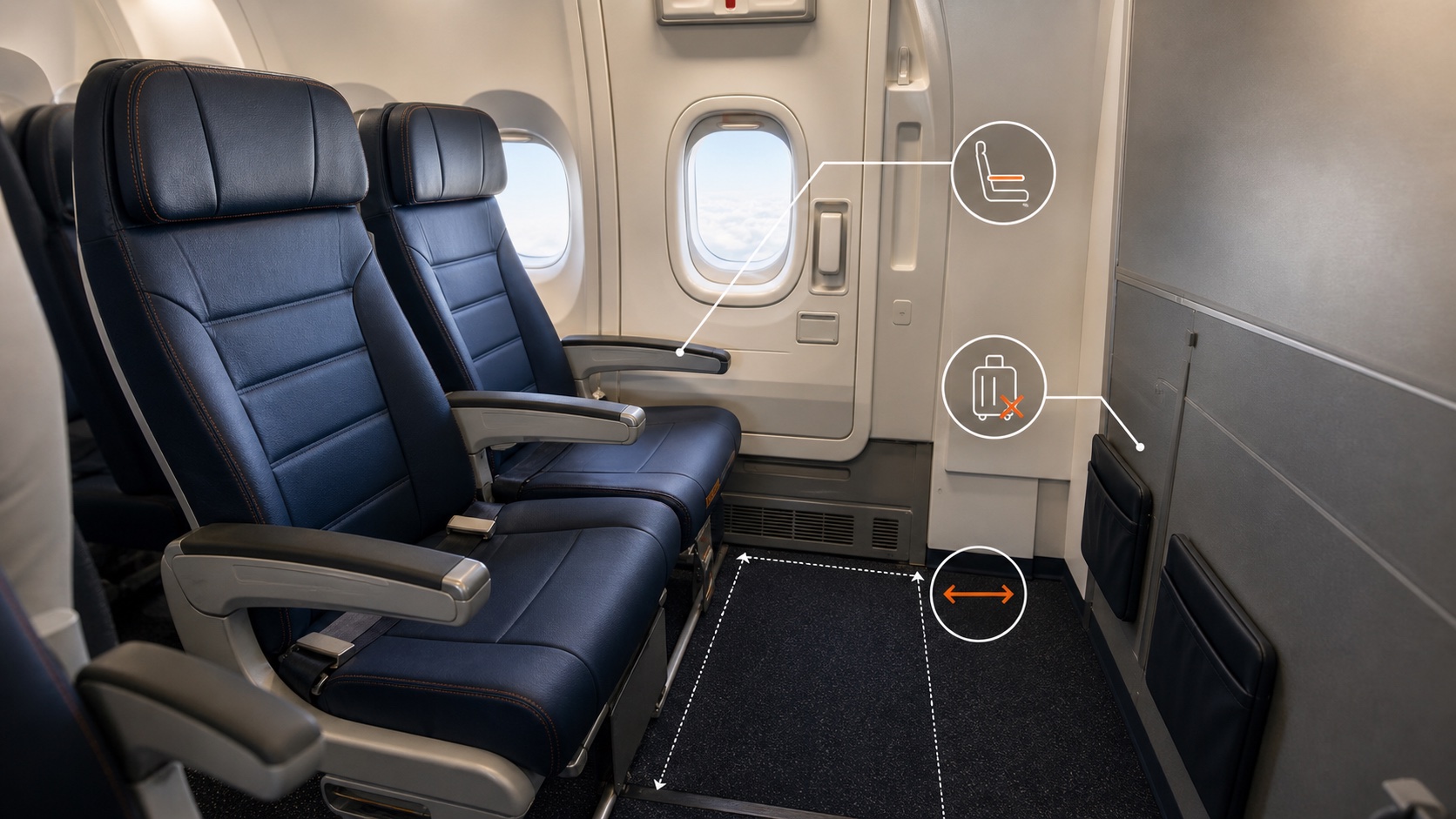
If you have the option to pick an exit row, it is usually worth it, but some are far better than others. They offer significantly more legroom than standard seats, sometimes double the pitch, and they're often available without an upgrade to premium economy. They also come with rules, trade-offs, and quirks that many travellers don't fully understand until they are buckled in.
This guide covers who can sit in an exit row, what you give up in exchange for the space, and the specific rows worth targeting on popular aircraft.
Take the exit row if legroom matters and you can live without under-seat storage at takeoff and landing. Skip it if you need easy bag access, a movable armrest, or reliable recline on a long overnight flight.
The first true exit row with a clear gap in front.
The row in front of an exit, which may have no recline and no extra space.
Tall travellers on flights over three hours who do not need a bag at their feet.
What makes exit row seats special
Exit rows are positioned at the aircraft's emergency exits — the overwing exits on most narrow-body aircraft, and the door exits on wide-body aircraft. Because the area in front of the exit must be kept clear for emergency evacuation, the seats facing the exit have significantly more legroom.
Typical seat pitch in economy is 30–32 inches. Exit row pitch can range from 34 to 44 inches depending on the aircraft and airline. On some aircraft, exit rows offer more legroom than business class seats on short-haul flights.
The extra space isn't just about legroom, either. Exit rows often feel more open because there's no seat back directly in front of you (or it's farther away), giving you more psychological breathing room on a crowded flight.
Who can sit in an exit row?
Airlines are required by aviation regulators (FAA in the US, EASA in Europe, and equivalents worldwide) to ensure that exit row passengers can assist in an emergency evacuation. The specific requirements vary slightly by airline and country, but the general rules are:
You must be:
- At least 15 years old (varies by airline — some require 16 or 18)
- Physically capable of opening the emergency exit door or hatch, which can weigh around 40–50 pounds on many aircraft
- Able to understand and follow crew instructions in the airline's operating language (usually English)
- Willing to assist in an emergency evacuation
- Not travelling with an infant or child who requires your constant attention
- Free of conditions that would prevent you from performing exit row duties (mobility impairments, visual or hearing impairments that would prevent understanding crew instructions, etc.)
You cannot sit in an exit row if:
- You're travelling with a lap infant
- You're a minor below the airline's minimum age
- You have a physical condition that prevents you from lifting the exit door
- You don't speak the language well enough to understand crew instructions
- You simply tell the crew you're unwilling to assist (they must reseat you)
Flight attendants will verbally brief exit row passengers before departure and confirm that each person understands their responsibilities. If they determine that a passenger doesn't meet the requirements, they have the authority, and the obligation, to reseat that passenger.
What you gain, what you give up
| Factor | How it works | What to check |
|---|---|---|
| Legroom | Exit rows can run around 34–44 inches of pitch, compared with roughly 30–32 in standard economy. | Confirm it is the true exit row, not the restricted row in front of it. |
| Movement | The clear space makes it easier to stand, stretch, and settle in on longer flights. | Some window seats beside exits can feel cooler than standard rows. |
| Storage | The exit area stays clear for evacuation. | Your bag usually goes overhead for takeoff and landing. |
| Seat hardware | Tray tables often move into the armrest, and armrests may be fixed. | The seat can feel narrower, and the armrest may not lift. |
| Recline | Some exit rows recline normally. | Rows in front of another exit row may have limited or no recline. |
Which exit rows are best on popular aircraft
Not all exit rows are equal. Here are the rows worth targeting on common aircraft types. Verify against the specific seat map on SeatMap.app first, as configurations vary by airline.
Boeing 737 (all variants: 737-800, 737 MAX 8, etc.)
The 737 family typically has two overwing exit rows on each side, and the exact row numbers move between airlines — so read them off the seat map rather than trusting a fixed number. The distinction holds whatever the numbers:
- The first exit row is the one you want: it faces a wall or a clear gap for maximum legroom, and the window seat is the pick.
- The second exit row still has decent legroom, less than the first, but its seats usually recline normally, whereas the first exit row often cannot.
The row to ask for: the first of the two overwing exit rows, window seat — confirm the number on your aircraft's seat map before you pay.
Airbus A320 / A321
Similar to the 737, the A320 family has two overwing exit rows:
- First exit row: Outstanding legroom, especially in window seats. On the A321, the exit row pitch can exceed 40 inches.
- Second exit row: Good legroom, better recline options.
Worth targeting: First exit row, window or aisle seat. On the A321, the first exit row is particularly spacious.
Boeing 777
The 777 has door exits rather than overwing hatches, and the exit rows are at various points through the economy cabin:
- Mid-cabin exit rows offer tremendous legroom — sometimes 38+ inches — and the seats are full-width (no armrest tray table on some configurations).
- On some airlines, the 777 exit rows are designated as "extra legroom" seats and priced accordingly.
Strongest option: Mid-cabin exit row aisle seats, for the best combination of legroom and accessibility.
Boeing 787 Dreamliner
Exit row configurations on the 787 vary significantly by airline. Some 787s have overwing exits with traditional exit row seating, while others use door exits further down the cabin.
Where to look: Check the specific airline's 787 seat map. Start with the airlines directory to find your carrier.
Airbus A380
The A380's exits are at the door positions on both decks. Economy exit rows on the lower deck can offer exceptional legroom:
- Exit rows near the mid-cabin doors on the lower deck are often the best economy seats on the entire aircraft
- Some airlines charge premium prices for these rows; others release them at check-in
The seat to target: Mid-cabin door exit row, aisle seat.
Tips for getting exit row seats
-
Select at booking if possible — Many airlines allow exit row selection for a fee at the time of booking. If the fee is reasonable ($20–50), it's usually worth it for flights over 3 hours.
-
Check in at exactly 24 hours — Airlines often release unassigned exit row seats at the online check-in window. Set an alarm and check in as early as possible.
-
Ask at the gate — If exit row seats are empty close to departure, gate agents may assign them to passengers who ask politely. This is especially common on less-full flights.
-
Use airline status — Frequent flyer elite members often get free access to exit row seating that is otherwise blocked or paid.
-
Know which exit row to target — the first of the two exit rows is usually the better one. Use the seat maps on SeatMap.app to identify exactly which row number to target on your specific aircraft.
-
Arrive early at the gate — For airlines that assign exit rows at the gate (some international carriers do this), being among the first at the gate gives you the best chance.
Common exit row myths
Myth: every exit row is free. Reality: Most airlines now charge for exit row seat selection. However, they're often released for free at check-in or at the gate.
Myth: you have to be strong to sit in an exit row. Reality: You need to be physically capable of operating the exit, but you don't need to be an athlete. The doors are designed to be operable by an average adult. That said, some overwing hatches are genuinely heavy (around 40–50 pounds), and if you have any doubts about your ability to lift them, it's better to sit elsewhere.
Myth: exit rows are dangerous. Reality: Research by Professor Ed Galea at the University of Greenwich, drawn from the seating charts of more than 100 plane crashes, found that survivors typically moved five rows or fewer to reach an exit. Sitting at the exit is, if anything, among the safer places to be.
Myth: all exit rows have the same legroom. Reality: The first and second exit rows can have very different amounts of legroom, and configurations vary significantly by aircraft and airline.
Choose the right exit row, not just any exit row
For more seat selection strategies, read our guide on how to choose the best airplane seat, and explore seat maps for all major airlines at SeatMap.app.
Exit row seats are one of the best values in air travel: premium legroom at a fraction of the premium-economy price. But the space comes with trade-offs, and the row in front of the exit can be worse than a standard seat. Know the rules, weigh the limitations, and target the true exit row for your specific aircraft — read the number off the map rather than trusting the first exit row you see.
It is the wrong seat if you travel with a lap infant, need a bag at your feet, or want reliable recline on an overnight — the fixed fittings and the clear-floor rule cost you all three. And on a short daytime hop, the extra inches rarely justify the fee. This is the seat for the tall traveller on the long flight who can live without a bag underfoot.