

How we'd pick the best airplane seat on any flight
Most people take whatever the airline assigns. Match the seat to the one job your flight needs it to do, and the right row picks itself. Here is the checklist.
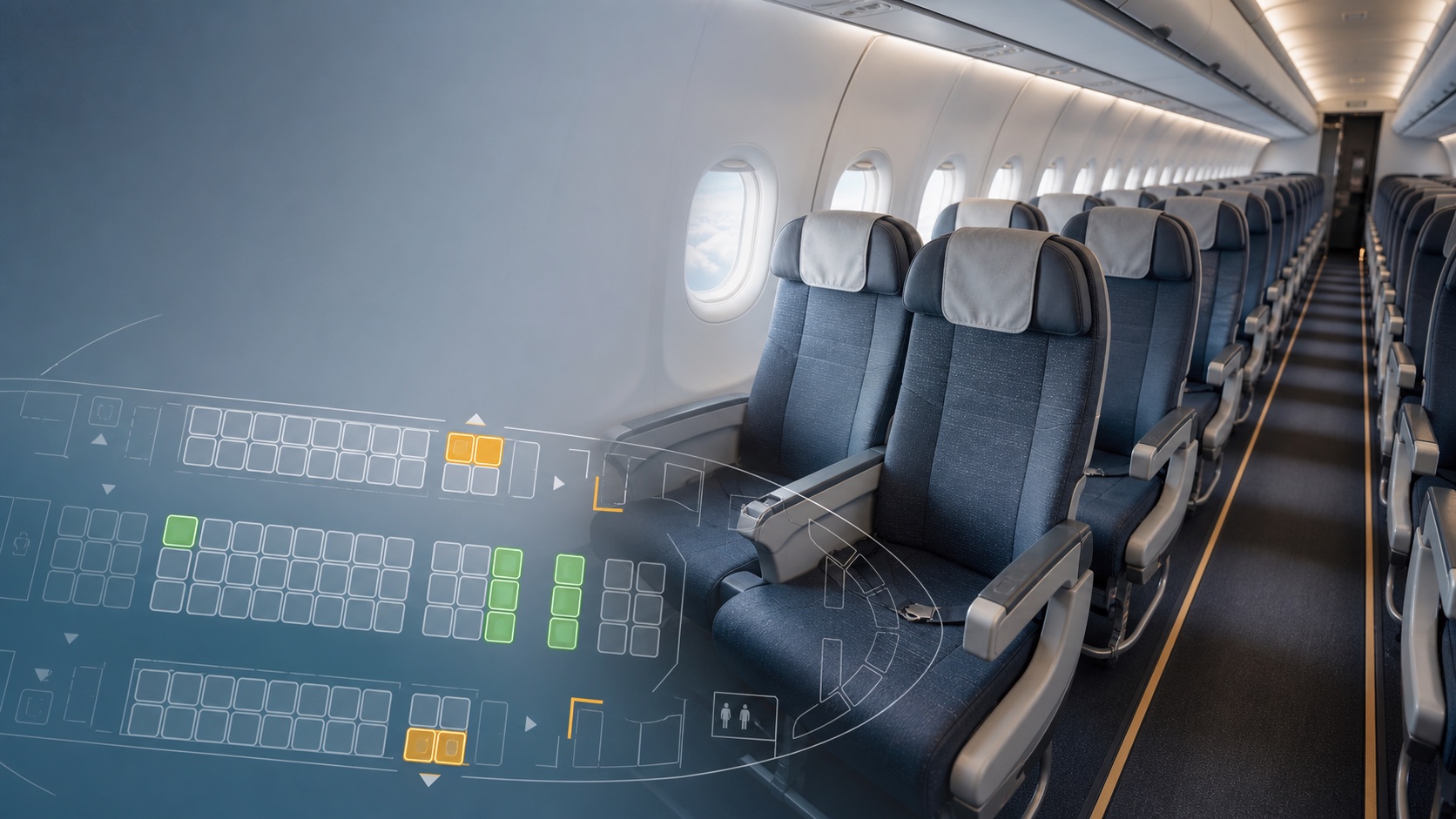
The seat you choose decides your legroom, how well you sleep, how much cabin noise you hear, and how fast you get off the plane. Most people accept whatever the airline assigns at booking and leave all of that to chance.
This guide walks through how to pick the seat that fits your priorities (legroom, quiet, a view, or a quick exit) and which rows are worth skipping. Use it as a checklist, then confirm the exact aircraft layout before you pay for a seat.
The fastest rule: pick a window if you want sleep, an aisle if you need movement, an exit row if legroom matters most, and the forward third of your cabin if quiet or a tight connection matters.
Window seat, forward of the wing, away from lavatories and galleys.
Exit row or bulkhead, checked against the exact aircraft layout.
The last row of a cabin section, especially beside lavatories.
Window versus aisle versus middle
Let's start with the most basic choice.
| Seat type | Best for | Trade-off |
|---|---|---|
| Window | Sleeping, views, privacy, photographers. | You are boxed in, especially on long flights when you want to move. |
| Aisle | Frequent lavatory use, quick exits, restless sleepers. | You take the bumps: carts, passing passengers, and neighbours climbing out. |
| Middle | Short flights or sitting with companions. | No view, no aisle access, and no wall to lean against. |
On wide-body aircraft, a window seat can feel surprisingly private. On red-eyes, the aisle can be better if you know you will get up. Middle seats are the compromise pick: acceptable with companions, painful when you are wedged between strangers for hours.
Seat pitch, width and recline
Three numbers define how comfortable your seat will be.
| Spec | What it means | What to look for |
|---|---|---|
| Pitch | The distance from one seat point to the same point on the seat ahead. | Below 32 inches feels tight for many taller travellers on flights over two hours. |
| Width | The usable space between armrests. | 17 inches is tight; 18 inches is common on wide-bodies; 19+ inches feels generous. |
| Recline | How far the backrest moves. | Last rows and seats in front of exit rows often have limited or no recline. |
Seat pitch is essentially your legroom. As a rough guide, 30–31 inches is standard economy, 34–36 inches is extra-legroom economy, and 38–42 inches is long-haul premium economy.
A single inch of extra width matters more than most people expect. It changes shoulder and hip comfort, especially when the person beside you is broad-shouldered too.
The exit row: extra legroom with strings attached
Exit row seats are the obvious first place to look if legroom matters. They can offer 35–40+ inches of pitch — sometimes even more. But they come with important caveats:
- You must be able-bodied and willing to assist in an emergency evacuation
- Minimum age requirements (usually 15–18 depending on the airline)
- No children or infants in exit rows
- Armrests may be fixed (they need to be immovable for evacuation purposes)
- Tray tables are in the armrest, reducing effective seat width
- No under-seat storage during takeoff and landing on many exit rows
- The row in front of the exit may have non-reclining seats
Not all exit rows are equal, either. The first exit row on wide-body aircraft often has more legroom than the second. Read our detailed exit row guide for a deep dive.
Bulkhead seats: the trade-offs
Bulkhead seats are the first row of a cabin section, positioned behind a wall (the bulkhead). They're often coveted, but they aren't the right pick for everyone.
Extra space, no one reclining into you, and often faster meal service.
Armrest tray tables, no under-seat storage, bassinet positions, and sometimes smaller screens.
Parents needing a bassinet, or tall travellers who can live with the storage trade-off.
If you're travelling with an infant and need a bassinet, a bulkhead seat is the one to book. If you want quiet on a long-haul flight, weigh up the chance of an infant beside you first.
Near the galley and lavatories
Seats near galleys and lavatories tend to be louder and more disruptive. Here's what to expect:
Galley-adjacent seats
- Crew members preparing meals at all hours (especially on long-haul flights)
- Clattering carts, running water, microwave beeps
- Brighter lighting when the rest of the cabin is dimmed
- Crew conversations
Lavatory-adjacent seats
- Constant foot traffic from passengers queuing
- Door opening/closing sounds
- Flushing noise
- Occasional odours on long flights
Rule of thumb: skip the last 2–3 rows of any cabin section — they tend to back onto the lavatories. Galley and lavatory placement shifts between aircraft, though, which is why our seat notes flag the specific seats: "row 31 backs onto the galley", "no window at row 14". Check the seat map for your aircraft before you commit to a row near the back.
Engine noise and turbulence
The physics of an airplane means that noise and vibration vary significantly depending on where you sit:
- Front of the aircraft — Quietest area. You're ahead of the engines (on most aircraft), and the sound waves travel backward. First and Business Class benefit from this positioning.
- Over the wings — Moderate noise but the smoothest ride in turbulence. The wings sit at the aircraft's centre of gravity, so they move the least.
- Rear of the aircraft — Loudest area. You're behind the engines, catching the full noise footprint. Turbulence is also felt more strongly at the back.
If you're a nervous flyer, sit over or just forward of the wings. If you want quiet, sit as far forward as your ticket class allows.
Special cases
Travelling with children
- Bulkhead seats provide bassinet mounting points for infants
- Window seats keep children entertained and contained
- Avoid exit rows — children under 15-18 (varies by airline) are not permitted
Red-eye and overnight flights
- Window seats let you lean against the wall to sleep
- Avoid bulkhead and exit rows — armrest tray tables are less comfortable for sleeping
- Avoid the back of the cabin — more noise and disturbance
Connecting flights
- Aisle seats near the front for quick deplaning
- Avoid the last 10 rows — you'll be among the last off, potentially missing tight connections
Tall passengers (6 feet+)
- Exit rows are your best friend
- Bulkhead seats offer legroom without the exit row restrictions
- Aisle seats let you stretch one leg out
- Avoid anything with pitch below 32 inches on flights over 2 hours
How to actually get the seat you want
- Select your seat at booking — Don't wait. The best seats are taken first.
- Check back at 24 hours — Airlines release held inventory at the check-in window. Premium seats that were blocked may become available.
- Use seat map tools — Check SeatMap.app to see colour-coded recommendations for your specific aircraft and airline.
- Try the Seat Advisor — Our advisor tool asks about your priorities and recommends specific seats based on what matters most to you.
- Ask at the gate — Gate agents can sometimes reassign seats, especially if the flight isn't full. Politely asking can yield surprising results.
- Monitor for aircraft swaps — Airlines sometimes change the aircraft on a route. If your plane gets swapped, your seat might change too. Check a day before departure.
What it comes down to
Start with the seat map for your next flight:
The right seat for you is already on the map. You just need to know what to look for.
Pick the seat for the one job the flight needs it to do: a window forward of the wing to sleep, an aisle near the front to move or make a tight connection, an exit row or bulkhead for legroom. Match the seat to the job and the rest of the cabin stops mattering. The same window in row 10 is a refuge for the sleeper and a trap for the aisle-pacer — the seat is not good or bad, it fits your flight or it does not.
If you are on a 90-minute hop with no bag and no preference, skip all of it — take what you are given and read a book. This is for the flight where the seat has a job: the overnight, the long-haul, the tight connection. And read the map for your exact aircraft before you pay, because the row numbers move between planes.