

The cheapest business award is often the oldest seat. Here's the fix.
Points blogs find the cheapest business award. Nobody tells you it routinely clears into the oldest seat on the plane. Here is how to book the cheapest seat actually worth having.
You did everything the points blogs told you to. You found the cheapest business-class award, transferred the points, and booked months ahead. Then a tired twin-aisle from 2009 rolls up to the gate, you fold yourself into an angled seat that tips you toward a stranger, and you climb over that stranger every time you need the bathroom for the next thirteen hours. You won the points game and lost the flight.
This is the redemption trap, and it is the part the award guides skip. The cheapest "business class" award routinely clears into the oldest hardware on the aircraft, because the price tracks the word "business", not the seat. Everyone can tell you which award is cheap. The thing nobody pairs with it is whether the cheap award is any good once you are sitting in it, and that is the half we can answer, because we hold individually checked seat maps for the aircraft these awards actually book.
One award, two completely different seats
Take United's 777-200. Spend your miles on a "Polaris business" award and you might draw a modern reverse-herringbone suite where every seat reaches the aisle. Or you might draw an older 2-4-2 layout where the window passengers are trapped behind their neighbours. Same airline, same cabin name, same number of miles. The seat is decided by which tail flies your route that day, and there is no reliable way to tell at the moment you book.
Delta makes it worse by not publishing an award chart at all. Prices float with demand, so a 2-2-2 relic on an older widebody can be priced like the brand-new doored Delta One Suite. You are paying suite money and gambling on whether a suite turns up.
That gap is the whole story, and it has a price tag. The cheapest award is rarely the best seat, and the best seat is rarely the cheapest award. The art is finding the cheapest award that still books a seat worth having.
Why it keeps happening
Award pricing is lazy in a specific way: it reads the cabin label and stops. A seat is "business" whether it is a doored suite from this year or an angled recliner from fifteen years ago, so the mileage rate treats them as the same product. They are not the same product. One is a bed with a door; the other is a wide chair you cannot quite sleep in.
Two forces make the trap deeper in 2026. Dynamic pricing is spreading, which unhooks the price from any fixed value and lets the airline charge suite rates for old metal. And fleets are mid-retrofit almost everywhere, so the same flight number flies the new seat one week and the old one the next. A reconfiguration takes years to work through a long-haul fleet, and during that stretch every award booking on a mixed fleet is a coin toss until you can see the specific aircraft.
The principle: good metal times good value
Here is the equation the rest of this piece runs on. The cheapest good seat is a product of two things: a sweet-spot loyalty programme with low cash surcharges, and a member airline that actually flies good hardware on your route. Points blogs own the first half. The second half is the one we built our seat-map guides around. You need both, because a brilliant award rate into an angled seat is a bad deal, and a superb seat priced at a fortune is one too.
The rest of this is how to line them up, starting from where you actually start: a pile of flexible points and a vague sense that you should "use them for business class".
Start with the points you already hold
Most people booking these awards are not loyal to one airline. They are holding a flexible currency from a credit card and deciding where to send it. So start there. The thing to remember above all else: transfers are one-way and irreversible, so confirm your exact award seat is bookable before you move a single point.
- Amex Membership Rewards is the broadest wallet, with a route into all three alliances: Aeroplan, ANA and Avianca for Star Alliance; Avios, Qatar and Cathay for oneworld; Flying Blue and Virgin Atlantic for SkyTeam, plus it is the only bank currency that reaches Delta.
- Chase Ultimate Rewards transfers at full value to everything it touches: United and Aeroplan for Star, Avios for oneworld, Flying Blue and Virgin for SkyTeam. It does not reach Cathay, American or Delta.
- Capital One has the broadest oneworld reach (Avios, Asia Miles, Qantas, JAL) plus Aeroplan and Flying Blue.
- Citi ThankYou covers the Star Alliance ticketing trio of Turkish, Avianca and Singapore, plus Avios and Flying Blue.
- Bilt is the only major currency that reaches Alaska, which matters more below than its size suggests.
Two friction facts deserve saying plainly, because they quietly waste a lot of planning. American AAdvantage is not a flexible transfer partner: you cannot feed it from Amex, Chase or Capital One, only from Marriott at a poor rate or by flying. And Korean Air's SKYPASS has no transfer partners at all, so it cannot be topped up from points in any practical way. If a guide tells you to "just transfer to AAdvantage", it has not checked.
The per-alliance playbook
For each alliance, the cheapest path to a genuinely good seat, and the cheap trap sitting next to it. Mile figures are approximate and move over time, so treat them as the shape of a deal rather than a quote.
Star Alliance: the marquee seat, if you dodge the relics
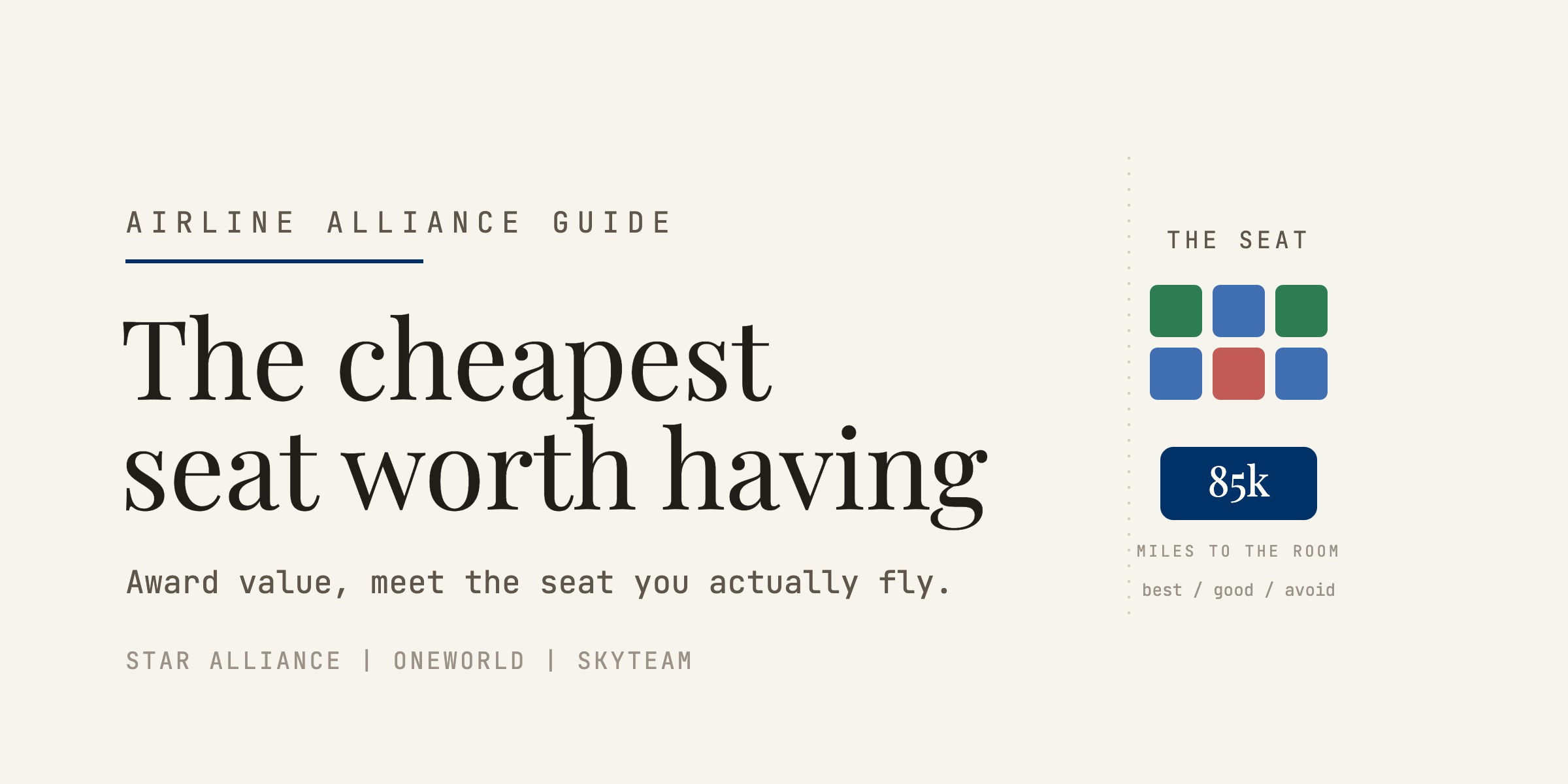
The win is ANA's 777-300ER and its seat called The Room, the widest business seat on this list and wide enough that people keep mistaking it for first class. Booked through Aeroplan it lands around 85,000 miles since the programme's June 2026 devaluation, still with low surcharges. EVA Air's 777-300ER Royal Laurel is a similar story at a similar Aeroplan rate, and it is reliably excellent up front.
There is a surcharge angle here that is pure free money once you see it. The new European hardware, Lufthansa's A350 with Allegris and SWISS's A350 with Senses, can be booked through Aeroplan or other chart programmes with no fuel surcharge, while booking the very same seat through certain other partners adds a four-figure cash bill. Same aircraft, same seat, a thousand dollars apart depending only on which programme you ticket through. These cabins are mid-rollout, so confirm the specific aircraft carries the new seat before you commit.
The trap is the old metal still flying under the same alliance badge. Air China runs angled 2-2-2 business with no aisle access on some long-haul routes, and parts of Air India's widebody fleet remain un-retrofitted. We do not hold those maps, so take that as a prose warning rather than a link. The in-fleet lottery we can show you is United's 777-200: the map shows the good reverse-herringbone Polaris seat, but the same flight might fly the older 2-4-2, so use the map to learn the good layout and then verify your tail number before you count on it.
oneworld: the dream alignment
This is where the best seat and the cheap award line up most cleanly. Qatar's Qsuite on the 777-300ER is the benchmark business seat, with a closing door and a quad layout for groups, and it books through AAdvantage from around 70,000 miles with clean surcharges. The best hardware in the sky at a sweet-spot rate is the alignment every other booking wishes it had. One caveat: a small share of Qatar's 777s are not yet Qsuite, so if you want to be sure of the door, the A350-1000 is the safer pick. JAL's A350-1000 is another clean AAdvantage win from roughly 60,000 miles, and Cathay's 777-300ER with the new Aria Suite books well through Alaska's Atmos Rewards for noticeably fewer miles and less cash than going through Asia Miles for the same seat.
The trap wears a friendly Avios price. British Airways transatlantic business looks cheap until you add roughly $400 each way in surcharges, and on the older Gatwick 777-200ERs you can still draw a dated 2-4-2 Club World cabin rather than the new Club Suite. The BA 777-200ER map shows how the business cabin varies by aircraft as the fleet upgrades, which is the point: confirm your aircraft has the Club Suite before you treat the cheap fare as a good one. And Finnair's A350 carries the alliance's most divisive seat. Its AirLounge business lies fully flat, but it does not recline in the usual way: you slide down into a fixed shell, with a tight footwell outside the bulkhead rows. Some travellers sleep brilliantly in it, others struggle to settle, so it is worth knowing what you are booking rather than assuming.
SkyTeam: the cleanest win of all
The standout is not the flashiest seat; it is the safest cheap one. KLM's 777-300ER finished its fleet-wide retrofit to a doored 1-2-1 cabin at the end of 2024, which means there is no old metal left to book by accident. Pair that with a Flying Blue Promo Rewards discount, which rotates monthly, and the seat can drop near 45,000 miles. A reliably good seat at a low rate with no lottery attached is the best risk-adjusted redemption in this whole piece.
The Delta One Suite on the A350 is a genuinely good doored seat with low surcharges, though Delta's chartless pricing means you are watching for a flash sale rather than a fixed rate, often in the 97,000 to 115,000 range. Delta also flies the suite on its A330-900neo, worth knowing even though we do not yet hold that specific map. There is a dark horse worth a mention: China Eastern flies the same doored seat shell as the Delta One Suite and prices it cheaply, though we do not hold that map either.
Two traps here, and the corrections matter. Air France is a per-flight gamble: its 777-300ER carries an excellent new 1-2-1 business, but an un-retrofitted 2-3-2 angled cabin is still flying the same routes through 2026, so the award is a coin toss until you verify the aircraft. That uncertainty is exactly why KLM, not Air France, is the safe SkyTeam hero. The second trap looks premium and is not: Korean Air's A380 has an all-business upper deck that sounds like a dream, but the seat is an older 2-2-2 with no aisle access from the window pairs. Korean's good metal is on its 787-9 and A350-900, not the A380, so do not let the big jet fool you. One more, for the westbound traveller: routing Virgin Atlantic points into Delta One is a great deal from Europe to the US, but effectively dead in the other direction, where Virgin tacks on around a thousand dollars in surcharges that Delta itself does not.
The surcharge gotcha is half the value
Two travellers can book the identical seat on the identical flight for the identical number of miles and pay wildly different cash, purely because of which programme issued the ticket. Fuel surcharges are a per-programme choice, not a per-seat one. Booking Lufthansa or SWISS through a no-surcharge programme costs a thousand dollars less than booking the same seat through a partner that passes the surcharge along. A "cheap" BA award stops being cheap once $800 of round-trip surcharges land on the card.
So "which programme" is not a footnote to "which seat". It is half the value of the redemption. The cheapest good seat is the one where the programme is right, the surcharge is low, and the aircraft flies the new hardware, all at once. Miss any of the three and the deal quietly leaks money or comfort.
The 2026 picture, honestly
The ground is shifting under all of this. Dynamic pricing keeps spreading, fixed-value charts keep shrinking, and a few programmes devalued in the last year, Aeroplan in June 2026 and the Avios programmes across 2025. Delta still runs no chart at all. The durable value now lives in the chart-based Star Alliance programmes and in the monthly Flying Blue promotions, and when a transfer bonus appears, typically 25 to 30 percent, it is usually worth timing the move rather than transferring at parity. Treat every specific number in this piece as a snapshot, and treat the partner list the same way, because both move.
Two caveats are worth keeping in front of you on any award booking. Aircraft swaps happen after you book, so a confirmed good seat can quietly become a different one; re-check close to departure and after any schedule change. And transfer partners shift, so confirm the route still exists before you move points you cannot move back.
How to actually use this
So when you have found a cheap business award, do not transfer yet. Look up the exact aircraft, see whether it flies the good hardware or the old, and only then move the points. Start with our best seats guides, find the aircraft your award would book, and make sure the cheapest seat is also one worth having.
The durable rule survives every devaluation: find the award, then check the tail on the seat map before you transfer a single point. The programme gets you the price; the aircraft gets you the seat. You have to clear both gates, and the second is the one almost nobody checks — which is exactly why so many good awards turn into bad flights.
If you are booking a short daytime hop where any flat-ish business seat will do, this is not for you — take the cheapest number and move on. It earns its care on the overnight and the ultra-long-haul, where an angled 2-2-2 with no aisle access is a different flight from a doored suite, and the miles cost the same.
Frequently asked
- Which alliance gives the best business class for the fewest miles?
- There is no single answer, because the cheapest award and the best seat do not reliably line up. oneworld has the cleanest alignment: Qatar's Qsuite, one of the best business seats flying, prices at roughly 70,000 AAdvantage miles with low surcharges. SkyTeam has the safest cheap win: KLM's retrofitted 777 via a Flying Blue promo can drop near 45,000 miles, and because the whole fleet is doored, there is no old seat to book by accident. Star Alliance holds the marquee seat, ANA's The Room via Aeroplan from around 85,000 miles since its June 2026 devaluation, but you have to dodge the angled relics elsewhere in the alliance.
- What is the redemption trap?
- It is booking the cheapest business-class award and landing in the oldest seat. The award price tracks the cabin label, business, not the actual hardware, so the same number of miles can buy a modern doored suite or a decade-old angled seat with no aisle access. The same flight number often flies different aircraft on different days, which means the award you booked months ago is a coin toss until you see the tail. Checking the seat map for the specific aircraft is how you avoid it.
- I have Amex points. Which alliance can I reach?
- Amex Membership Rewards is the broadest wallet: it reaches every alliance. For Star Alliance it transfers to Aeroplan, ANA and Avianca; for oneworld to British Airways Avios, Qatar and Cathay; for SkyTeam to Flying Blue, Virgin Atlantic, and it is the only bank currency that reaches Delta. Transfers are one-way and irreversible, so confirm the award seat is available before you move anything. One friction fact worth knowing: American AAdvantage is not a flexible transfer partner, so you cannot top it up from Amex, Chase or Capital One directly.
- Is the cheapest business award worth it?
- Only if it clears into a seat worth sitting in. A cheap award into an angled 2-2-2 with no aisle access is a worse flight than paying a little more for a doored suite, and on a long overnight that difference is the whole trip. The trick is not chasing the lowest number; it is finding the lowest number that still books good hardware. That is why the seat verdict matters as much as the mileage rate.
- How do I avoid getting an old seat on an award?
- Find the award first, then check the seat map for the exact aircraft before you transfer any points. If the route flies a mix of old and new hardware, like several transatlantic 777s do, treat the booking as a gamble until you can confirm the tail number close to departure, and re-check after any schedule change, because aircraft swaps happen after booking. The cleanest wins are fleets that finished their retrofit, where every aircraft is the good one.