

Scoot's 787 comes in three versions — here's how to tell which one you'll fly
Book a Scoot flight and you might be sitting in a 787-8 with 335 seats, or a 787-9 with 375, depending on the day you fly. The flight number stays the same. The aircraft underneath it does not, and that changes which seat is the one to pick.
Scoot runs three different versions of the Boeing 787 across its network, and the airline books them fairly interchangeably. This guide covers what separates the three, how to work out which one your flight actually gets, and the specific seats worth choosing on each. We check the cabins by hand: Scoot's current official 787 product sheet is the source for the Stretch list and pitch figures, while our Scoot 787 seat maps show the cabin geometry.
787-8 (335 seats): book 9D to 9F, bulkhead row 4 or the outer seats of exit row 10; avoid rows 5 to 8 by the forward lavatories. 787-9 (375 seats): the extra legroom is paid Stretch (row 6, all nine seats in row 11, seats 30D to 30F, and the outer seats in exit row 31) and rows 6 to 10 are the paid Scoot-in-Silence quiet zone; most other seats are standard 31-inch economy, so just avoid the lavatory block at rows 28 to 30. Not sure which you're on? Check the aircraft for your date in our flight search first.
The three 787s at a glance
The differences are easy to miss on a booking page, because Scoot sells all three as "787". Side by side, they are three distinct aircraft.
| Version | Total seats | ScootPlus | Economy | Seat map |
|---|---|---|---|---|
| 787-8 (standard) | 335 | 21 seats, 2-3-2 | 314 seats, 3-3-3 | scoot-787-8 |
| 787-8B (crew rest) | 329 | 18 seats, 2-3-2 | 311 seats, 3-3-3 | scoot-787-8b |
| 787-9 (longer) | 375 | 35 seats, 2-3-2 | 340 seats, 3-3-3 | scoot-787-9 |
The 787-8 is the shorter airframe. Scoot flies it in two forms: a standard 335-seat cabin, and a 329-seat version that gives up six seats, three of them in ScootPlus, to carry a crew-rest module for longer sectors. The 787-9 is the stretched airframe, so it fits more of everything: a bigger ScootPlus cabin at 35 seats and 340 in economy. All three keep the same shape across the aisles, ScootPlus at 2-3-2 and economy at 3-3-3, which is why the useful question is not the layout but the length.
Which 787 is your flight?
This is the part no seat map alone can answer, and it is the reason this page exists.
Scoot rotates its 787s through the schedule, so a flight number that flew as one version last week can turn up as another this week. Our own flight history recorded Scoot's TR9 operating as the 335-seat 787-8 on some July days and the 375-seat 787-9 on others, inside the same fortnight. Nothing on the ticket changes when that happens, which is how a passenger ends up staring at a seat map that no longer matches the cabin they are standing in.
Here is how to pin it down before you choose a seat:
-
Start with the date, not the flight number. Put your flight number and travel date into our flight search. Within a day or two of departure, once Scoot has assigned the actual aircraft, we match its registration to the exact 787 in our data and show you that cabin. That is the confident answer.
-
Read a longer-range result as a forecast. Book further out and we show the version that flew your route most often over the recent history we hold. It is a good guide, but it is a prediction, not a certainty. An aircraft swap for maintenance or a schedule change can still put a different 787 on your gate on the day.
-
Use the registration if you can see it. Scoot's 787-8s tend to wear 9V-OF tails and the 787-9s tend to wear 9V-OJ, so the registration on your boarding confirmation or the airport board is a quick tell once the aircraft is set.
The honest limit is this: no tool can promise the aircraft for a flight three months out, because Scoot has not decided it yet. What we can do is show you the aircraft the moment it is assigned, and give you the odds until then.
Scoot 787-8: best seats
The standard 787-8 seats 335. Economy runs 3-3-3 from row 4 back, and the seats that stand out are the ones with real legroom rather than a particular window.
The outer seats of row 10 are sold as Stretch with extra legroom and no bulkhead in front. Exit-row rules apply, so nothing stays at your feet for take-off and landing. The middle seats, 10D to 10F, are standard pitch.
The first economy row, sold as Stretch, with extra legroom and a wall ahead. No under-seat storage for take-off and landing is the trade.
A lavatory block sits just behind the front economy rows, so these seats pick up queue traffic for the whole flight. Our map flags them one by one.
The other cluster to avoid is rows 26 to 29, where a second lavatory bank sits mid-cabin. The rear of economy, rows 41 and 42, backs onto the galley and lavatories and is last off the aircraft. If you want a window, take one in the forward half of economy rather than 7A, which our map flags as a wall with no window at all. Full detail is on the 787-8 seat map.
Scoot 787-8B: the same shape, six seats short
The 787-8B is the standard -8 with a crew-rest module fitted, and the passenger cabin pays for it. Total seats drop to 329, and ScootPlus shrinks from 21 to 18. Economy still runs 3-3-3, and the good and bad rows sit in much the same places: 9D to 9F, bulkhead row 4 and the outer seats of exit row 10 for legroom, the forward lavatory block behind rows 5 to 8 to avoid.
The one row that changes character is row 9, which our map rates well on the -8B for its extra legroom despite sitting near a lavatory. The practical point is simpler: if your booking shows 329 seats or an 18-seat ScootPlus cabin, you are on the crew-rest -8, and the plan is the same as the standard -8. Check the live 787-8B seat map for your date, because the ScootPlus rows differ from the other two aircraft.
Scoot 787-9: best seats
The 787-9 is the one to hope for if you want the most room to choose from. It seats 375, carries the largest ScootPlus cabin at 35 seats, and has the most economy inventory at 340.
| Seat | Verdict | Why |
|---|---|---|
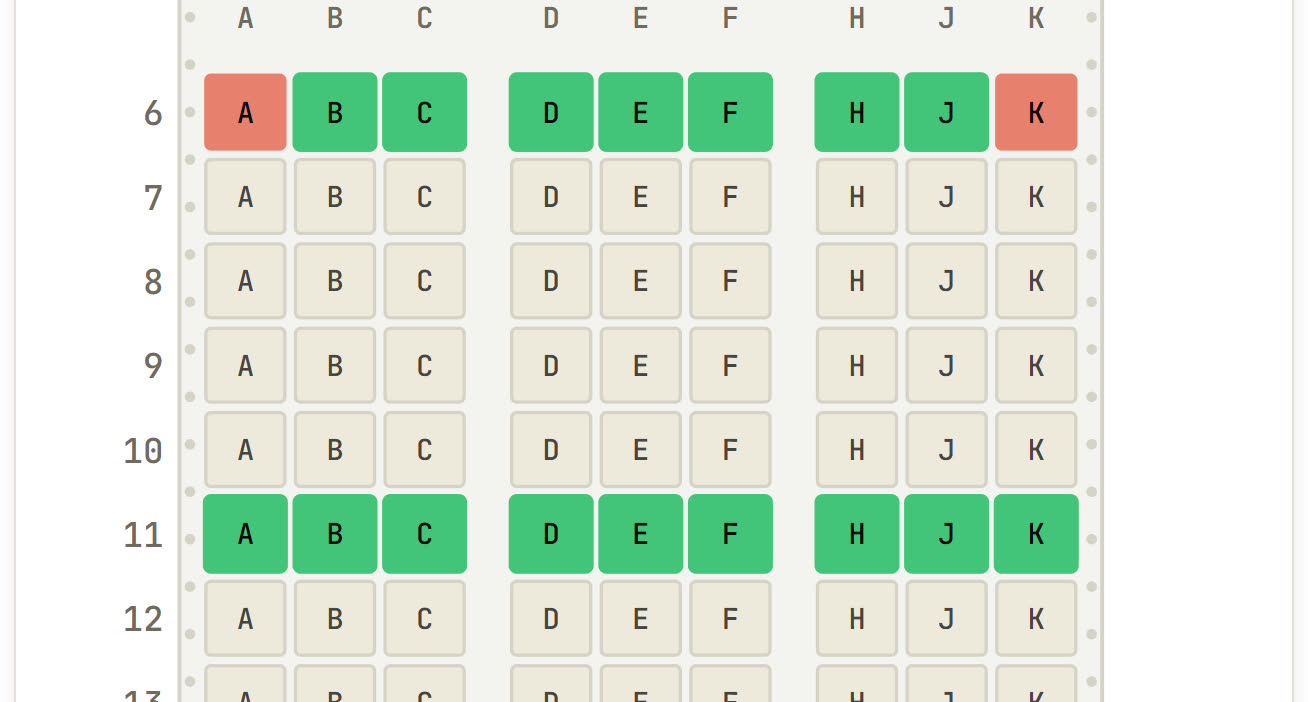
| Row 6 | Extra legroom, paid | The front economy row, sold as Stretch. Avoid 6A and 6K if a view matters; they face cabin wall with no window, while the row's other seats are middle or aisle seats. |
| Rows 7 to 10 | Quiet, paid | The Super seats in the Scoot-in-Silence zone: adults only, 33 to 34 inches of pitch, for a fee. |
| Row 11 (all seats) | Extra legroom, paid | Every seat is Stretch. The centre block, 11D to 11F, has an exceptional 48.5-inch pitch; 11A to 11C and 11H to 11K have 34 inches. |
| Row 31 (exit) | Outer seats: extra legroom, paid | Scoot lists the six outer seats, 31A to 31C and 31H to 31K, as Stretch at 34-inch pitch. Exit-row rules and no bag at your feet apply. |
| Standard economy (most seats from row 12) | The free fallback | Most have 31-inch pitch. Scoot charges to pre-select any seat, so take your assignment if you are not paying, or sit forward and clear of the row-29 lavatories if you are. |
| Rows 28 to 30 | Avoid | A mid-cabin lavatory pair. Row 29 is a stub with only the A-to-C seats left, the rest given over to lavatories, and the seats at 30D to 30F pair their Stretch legroom with a lavatory directly in front. |
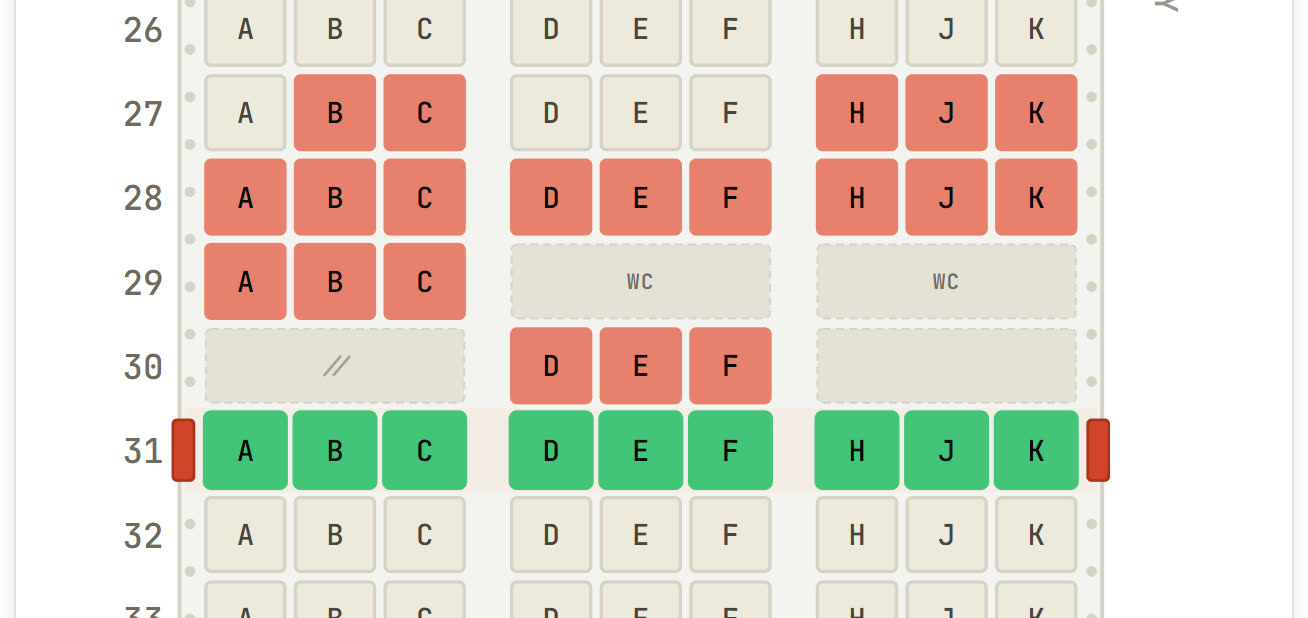
Two seats worth naming out loud: 6A and 6K read as window seats on the map and are sold as Stretch, but the fuselage tapers in at the bulkhead and neither one actually has a window beside it, only cabin lining. If the view matters, avoid row 6 rather than paying for another seat in it. The 787-9 seat map shows the mid-cabin gap around row 29 clearly, which is the fastest way to see why the rows around it draw so much traffic.
Where ScootPlus, Stretch and Scoot-in-Silence fit
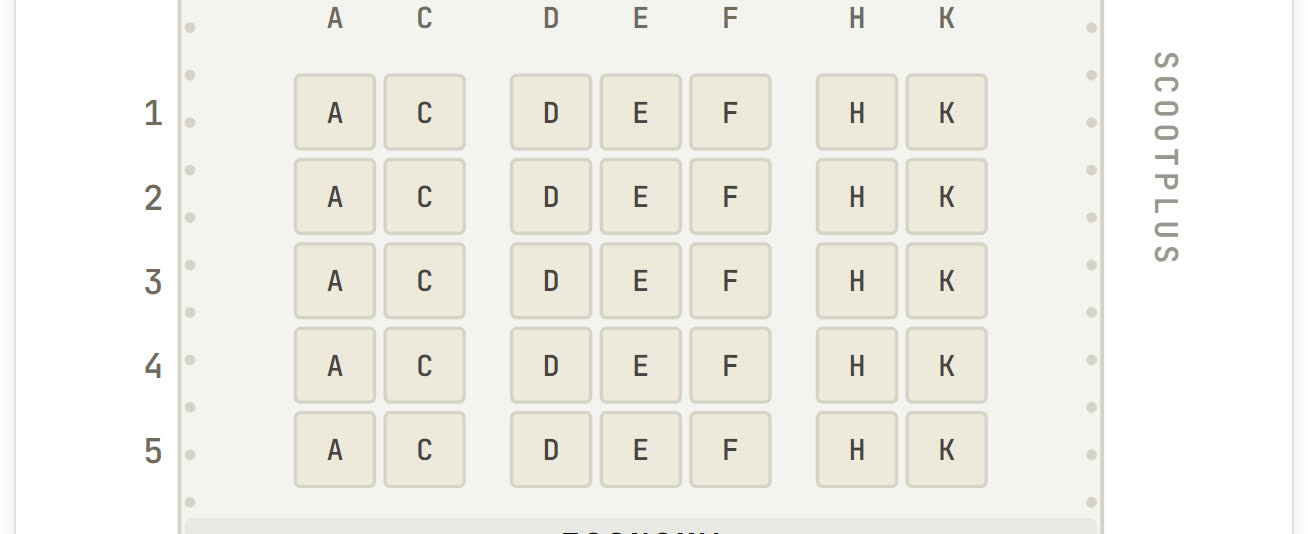
Neither product is a business seat, and it helps to know that before you pay. ScootPlus is a recliner in a 2-3-2 cabin up front, with more width, more recline and more legroom than economy, plus a baggage and meal allowance. On a daytime hop it is a genuine comfort step up. On a red-eye it narrows the gap to a good economy row rather than closing it, because it does not lie flat.
Stretch is Scoot's name for the extra-legroom economy seats, priced above a standard seat. Scoot's current 787-9 product sheet lists row 6, all of row 11, the centre block at 30D to 30F, and the outer seats in exit row 31 as Stretch. Row 11's centre block, 11D to 11F, stands apart with 48.5-inch pitch; its six outer seats have 34 inches. On a long sector Stretch seats are the cheapest real gain in comfort, with the caveats that a bulkhead means no bag at your feet, an exit row comes with responsibilities, and the 30D to 30F block sits right beside a lavatory.
Scoot-in-Silence is a third paid option: an adults-only quiet zone across rows 6 to 10, where the Super seats at rows 7 to 10 add a little pitch over standard. Most remaining economy seats have 31-inch pitch, and Scoot charges to pre-select any of them, so the only free seat is the one you are handed at check-in.
Bottom line
Scoot's 787 is really three aircraft, and the seat you want depends on which one turns up. If you are on the 787-9, the roomier and quieter seats are all paid: Stretch for legroom (row 6, any seat in row 11, seats 30D to 30F, or the outer seats in row 31) and Scoot-in-Silence for quiet (rows 6 to 10). In row 11, the centre block has 48.5-inch pitch and the outer six seats have 34 inches. Most other seats are standard 31-inch economy, so pay only for position or take the seat you are given, and steer clear of rows 28 to 30. On either 787-8, the exit row and the bulkhead are the seats to hold out for, and the forward lavatory block behind rows 5 to 8 is the trap. Before any of that, settle the real question first: check which 787 your flight gets for your date, then pick the seat to match.
One traveller can skip all of this: anyone on a short Scoot sector who has not paid to choose a seat. Take what you are given, and the gap between row 12 and row 29 costs you an hour of mild annoyance rather than a night of sleep. On the long hauls it runs the other way, which is where two minutes of checking pays for itself.
Compare all three side by side on the Scoot seat maps, or read how we build them in how our seat maps are made.
Frequently asked
- How many versions of the 787 does Scoot fly?
- Three. Scoot operates a standard Boeing 787-8 with 335 seats, a second 787-8 variant with 329 seats that carries a crew-rest module, and a longer Boeing 787-9 with 375 seats. All three run ScootPlus up front in a 2-3-2 layout and economy behind in 3-3-3, but the seat counts, the size of the ScootPlus cabin and the position of the lavatories differ between them.
- How do I know which 787 my Scoot flight uses?
- Enter your flight number and date into our flight search. Within a day or two of departure, when the aircraft is assigned, we match its registration to the exact 787 in our data and show you that cabin. Further out, we show the version that flew your route most often over the last month, which is a reliable guide rather than a promise. Scoot can still swap the aircraft at short notice for operational reasons.
- Does Scoot really change the aircraft on the same flight number?
- Yes. Our own flight history recorded Scoot's TR9 operating as the 335-seat 787-8 on some July days and the 375-seat 787-9 on others, within the same fortnight. The flight number stays the same while the aircraft rotates, which is why a seat map saved for last time may not match this time.
- What are the best economy seats on Scoot's 787?
- On the 787-9, every roomier or quieter economy seat is paid. All nine seats in row 11 are Stretch: 11D to 11F have 48.5-inch pitch, while 11A to 11C and 11H to 11K have 34 inches. Row 6, seats 30D to 30F and the outer seats in exit row 31 are also Stretch. Rows 6 to 10 form the Scoot-in-Silence zone, quieter and adults-only for a fee. Most other economy seats have a standard 31-inch pitch, and Scoot charges to pre-select any seat, so a truly free seat is the one you are assigned. On both 787-8 variants, the most legroom is in 9D to 9F and the bulkhead row 4, both sold as Stretch, with the outer seats of exit row 10 next. Across all three aircraft, avoid the seats flanking the lavatory blocks, which our maps flag row by row.
- What is ScootPlus and is it worth it on the 787?
- ScootPlus is Scoot's premium cabin, laid out 2-3-2 at the front of the aircraft with wider seats, more recline and more legroom than economy. It is a recliner, not a lie-flat business seat, so on an overnight it narrows the gap to a good economy row. The 787-9 carries the largest ScootPlus cabin at 35 seats; the two 787-8s carry 21 and 18.